Showing posts with label disney. Show all posts

Thursday, 22 June 2023

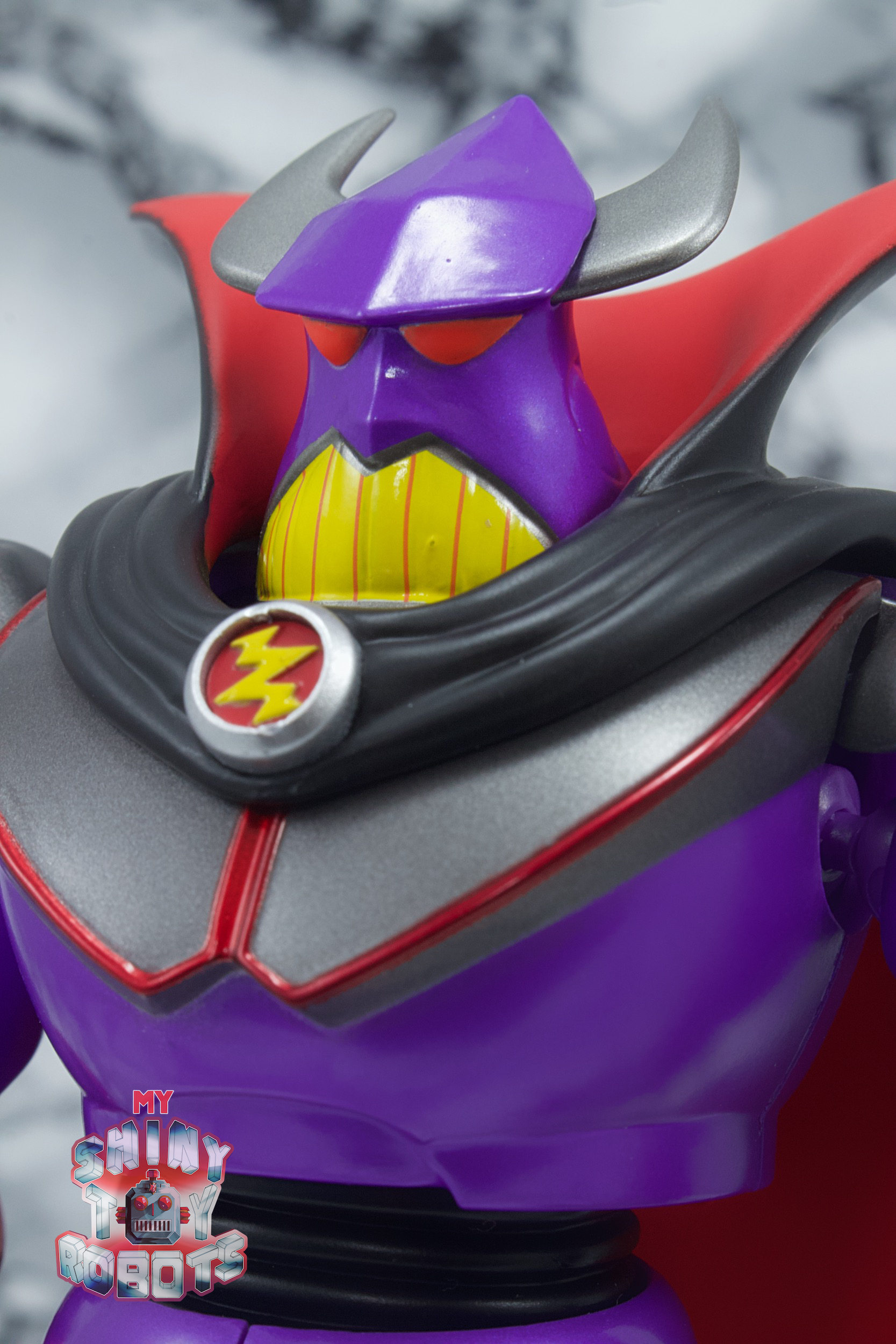
Toybox REVIEW: Revoltech Zurg (Toy Story)

Revoltech Emperor Zurg 01

Release Date: March 2023
RRP: 11,880 yen

Even without appearing in the first Toy Story movie, the name "Emperor Zurg" immediately latched onto me. In amongst all the other fantastic things going on in the film I wanted to know more about Buzz Lightyear's sworn enemy, and when he finally appeared in Toy Story 2 I was not disappointed. That love continued on with the Buzz Lightyear of Star Command cartoon (where he was brilliantly voiced by Wayne Knight) and the Buzz Lightyear's Space Ranger Spin Disney Parks ride. Not so much 2022's Buzz Lightyear movie, but the less said about that the better. However despite this love I've never owned a good Zurg toy, so naturally Kaiyodo made my dreams come true when they announced Revoltech Zurg (Toy Story) would be joining Woody and Buzz as part of the Revoltech line. Despite releasing not too long after Buzz's solo movie, this figure is based on Zurg's original appearance as the sworn enemy of the Galactic Alliance.

Sunday, 26 July 2020

Toybox REVIEW: Disney Select V.I.N.CENT & B.O.B.

Disney Select V.I.N.CENT & B.O.B. 01

Release Date: February 2020
RRP: $24.99/£29.99

Coming from a time when the world was very much caught in a Star Wars frenzy, it isn't any surprise that the most memorable characters of Disney's The Black Hole are its robots. It may have tried to incite terror with the crimson Maximilian, but it also went for the "cute and sassy" market too with its hero robots. V.I.N.CENT (Vital Information Necessary CENTralized) is part of the U.S.S. Palomino crew that finds itself aboard the U.S.S. Cygnus, where he meets an older model in his series - B.O.B. (Bio-Sanitation Battalion). B.O.B. helps the crew unravel the mysterious of the Cygnus and its captain Dr Hans Reinhardt, but is sadly killed by Maximilian during their escape. V.I.N.CENT on the other hand makes it out alive, journeying with the other survivors into the titular black hole. Both robots have been immortalised alongside Max in Diamond Select's Disney Select toy line, quickly becoming must-have releases for fans of this fun but somewhat troubled film.

Wednesday, 8 July 2020

Toybox REVIEW: Disney Select Maximilian

Disney Select Maximilian 01

Release Date: February 2020
RRP: $24.99/£29.99

The Black Hole is 1979 film by Walt Disney Productions, released during a time when every film company was desperate to be the one to make the next Star Wars. At the time it was the most expensive film the Disney produced, and despite featuring some rather grand (and at times dark) ideas the film generally failed to capture the hearts and minds of audiences and critics alike. Over the years it has amassed some cult following though, and ever since seeing the film as a child it’s always been one of my favourites as well. Largely thanks to its great robot designs, which have received a fair few toys over the years but never anything that’s been particularly high-end/affordable. Now after all these years Diamond Select have finally stepped in with their Disney Select range, and I’ve finally added Disney Select Maximilian to my collection. The figure was designed by Yuri Tming, and sculpted by Gentle Giant Studios.

Saturday, 5 March 2016

Toybox REVIEW: S.H. Figuarts Captain Phasma


When the marketing for Star Wars The Force Awakens went into overdrive there were a select few characters who quickly became the subject of much discussion. The identify of mysterious new villain Kylo Ren was one such talking point, however eyes were also drawn to a Stormtrooper leader decked out in a cape and shiny silver armour. This of course is Captain Phasma, First Order Stormtrooper Captain and played by Gwendoline Christie. Due to Christie's acting experience in Game of Thrones and her generally badass look, Phasma was touted as being one of the things to look forward to most in the film with many people labelling her "the next Boba Fett". This unfortunately turned out to be more accurate than people hoped, with Phasma herself doing extremely little in the film and coming away feeling like a throwaway character more than anything else. Still, the design looked fantastic and so it's no surprise to see Bandai Tamashii Nations add her to their steadily-growing collection of Star Wars themed S.H. Figuarts - making her the third release from the newest instalment. 

Tuesday, 23 February 2016

Toybox REVIEW: Figure Complex Movie REVO Stitch


It wasn't that long ago that Kaiyodo's Revoltech line was one of the most talked about and eagerly anticipated Japanese toy lines among collectors, providing a wide variety of mecha, anime girls, tokusatsu kaiju and Western movie characters among its various divisions. But times change, and as the likes of S.H. Figuarts, Super Robot Chokogin, Robot Damashii and Figma became more and more prevalent Revoltech figures started to die down a bit in popularity. However the line never truly went away, and has recently reinvented itself with a number of different lines all working under a "Powered by Revoltech" tagline. Among these is a new Figure Complex MOVIE REVO line seemingly dedicated to Western film properties, including Back to the Future and The Avengers: Age of Ultron. The third entry however is a Disney character that's proven just as popular in Japan as he has in the West, going as far as to receive a long-running anime spin-off series that. He is of course Experiment 626, aka Stitch from Lilo & Stitch.

Friday, 11 January 2013

Game REVIEW: Epic Mickey: Power of Illusion (3DS)


While video gaming reviews aren't a regular feature on this blog, every so often there comes a game which I feel I should make an exception for. The original Epic Mickey game for the Nintendo Wii came out of nowhere and quickly became one of my favourite Wii games, so you can imagine my excitement when not one, but two sequels were announced. While the first was a straight console sequel entitled The Power of Two (which I'm currently playing through and will be reviewing in the near future), the second was a lot more interesting. Not only was it a 2D side-scrolling handheld title for the 3DS, but a spiritual sequel to the excellent Mickey Mouse: Castle of Illusion game for the Sega Mega Drive (or Genesis if you'd prefer). With the weight of two great games behind it, is Epic Mickey: Power of Illusion a game worthy of both legacies?

Apparently set after the events of The Power of Two (although outside the game manual there's no indication of this), the game sees Mickey returning to Wasteland to once again battle the evil witch Mizrabel (the villain from Castle of Illusion) after she and her castle are sent there. Not liking that she's been sent somewhere where forgotten toons go, Mizrabel plots her return by kidnapping Minnie Mouse and a variety of various characters from across Disney-dom - planning to steal their heart power. With Pinocchio's Jiminy Cricket acting as his guide, Mickey ventures through the Castle of Illusion once again!


If you're familiar with the original Castle of Illusion game, immediately you'll be treated by a number of nostalgic sights and sounds. From Mickey's jumping noise to the mushroom enemies that appear in every level, developers Dreamrift have a great deal to tie things in to the previous game. However whether they've gone as far as they could have gone is debatable, as a few opportunities are missed along the way. While in the original game Mizrabel took her design cues from Snow White's wicked Queen, this time around she's supporting Sleeping Beauty's Maleficent's skin...literally. Her first appearance see her morphing into a variety of Disney villains, but this original form is sadly never seen.

Mickey's throwing ability is obviously gone, replaced with projectile attacks via the paintbrush (be it paint or thinner). The morality element of the console Epic Mickey games is gone, with which element of the brush you use making no difference on enemies themselves. These tools really come into play with the interactive items you'll come across in the levels, which can be drawn or rubbed out as you desire. These items range from platforms and magic carpets to firing cannons and octopuses. Drawing these in requires tracing an outline on the 3DS touchscreen, and just how closely you follow the outline will determine how useful they are to you. It's an interesting approach, but so incredibly easy to do that even a child could breeze through the game without learning the effects of poorly drawing something.


As far as levels are concerning, the offering is incredibly meagre. There are a total of three worlds in the game, each split into four levels and one (super easy) boss. The first world is based on Neverland with Captain Hook as the boss, the second Agrahbah and Jafar and the third world Atlantis - only Ursala isn't the boss here, instead they just go straight to the final Mizrabel boss and Ursala is reduced to being an interactive character (more on that in a moment). It feels like they just give up on things at the last minute. The levels aren't really all that challenging until you reach the last few Atlantis ones (which are more frustrating rather than hard). All the levels require visiting more than once, but while repeated trips make the game last longer, they don't make up for the abysmal length of the game. Even a casual gamer could probably finish it in one sitting.

Where the game really shines is its extended cast of characters. The Epic Mickey side of things might as well just be forgotten, because there aren't any "forgotten" characters and Oswald is barely in it. Instead on your travels you come across a HUGE variety of characters from various Disney movies including Aladdin, The Little Mermaid, Tangled, The Lion King, The Princess and the Frog, Snow White and more. As you rescue these characters, they take haven in their  own little rooms in the castle's "fortress", making them up to look like home.Talking to the characters then opens a variety of side quests, which include finding extra characters for their rooms (e.g. finding Timon and Pumbaa for Simba), items (a frying pan for Rapunzel) or simply just drawing things for bonus items. Successfully completing a mission results in the rooms improving bit by bit. Room improvement can also be done via upgrade stars, which are awarded for completing levels and later buyable from the peddlar from Aladdin. Best of all, Power of Illusion is one of the few places you'll see these characters interact with each other too.


But this is the problem. The game feels less like a side-scrolling adventure, and more a game of "dress up your Disney characters room". The quests are mundane and repetitive, lacking variety as its just the same thing over and over with interchangeable characters and items. The cast is huge, but when its clear that the majority of effort when into the SIDE quests the overall game really suffers. While the mainline Epic Mickey games over decent replay value in terms of alternate paths and collectible items, there is nothing here that would make you want to pick the game up twice.


I had huge hopes for Power of Illusion, so much that I was looking forward to it more than The Power of Two. But unfortunately this game is barely worthy of either the Epic Mickey or Illusion titles. The 3D is pointless, the game painfully short and the bosses unimaginative. Its great to see so many mainstream Disney characters under one roof, but their inclusion also feels like it goes against the whole point of Epic Mickey. Power of Illusion is a great game for kids, but a massive disappointment compared to the titles it succeeds.

Wednesday, 15 August 2012

Anime REVIEW: Fireball/Fireball Charming

Fireball and Fireball Charming logos

The latest anime series I've watched is a bit of an oddity, and certainly not something you might expect from a company such as Disney. Fireball and its second season Fireball Charming are two 13-episode series created by Jinni's Animation Studios in conjunction with Disney. Each episode is just over a minute in length, and created entirely with CGI. The original series ran between April and June 2008, while Charming aired during the same months in 2011.

Disney Fireball Drossel and Gedachtnis
Meet Drossel, manufactured with the mind of a 14 year old.

The series follows gynoid Duchess Drossel von Flügel (title and full name: the 19th Lord of Uranos' Kingdom's Tempest Domain, Drossel Juno Vierzehntes Heizregister Fürstin von Flüge) and her massive cyclops robot servant Gedächtnis. Episodes revolve around happenings in their giant manor house the Tempest Tower, and are set against what is presumably a war between robots and humanity (with humanity having taken an oppressed status). Fireball Charming is a prequel series, set in the year 48234 as opposed to the setting of the original, which was between 48650 and 48794.

Disney Fireball Drossel Flying Accessory
Who said that flying couldn't also be fashionable?

With episodes only having just over a minute of runtime, there's no time for proper build up and so the comedy has to come in relatively fast. For certain episodes this works quite well (such as Drossel's discovery of a new hairpiece) but other jokes will fall flat. The most obvious offender would be Drossel constantly calling Gedächtnis by a different name (such as Rasputin or Sancho Panza), which is funny at first but quickly gets old. The setting of machines at war with humans isn't particularly prevalent, but is often touched up in a way that makes you wish Fireball was something more than comedic one-shots. The final episode sees the main characters seemingly taking a last stand against a human uprising, with their fate left ambiguous. Too bad nothing further will probably ever come of it.

Disney Fireball Charming Drossel and Gedachtnis
Drossel and Gedächtnis sported a different look back in the year 48234

While Fireball may be a somewhat enjoyable yet pointless watch, prequel series Fireball Charming has a lot more going for it. Once again it takes the format of minute long episodes, but the humour has expanded beyond the same repetitive jokes. We see a lot more of Tempest Tower, along with more characters and a greater emphasis on sight gags to go along with the large amount of dialogue. Both Drossel and Gedächtnis have received a makeover (Upgrade? Downgrade?), with the former taking a much less humanoid form - complete with extended head section and tapered legs. This allows a much greater range of robotic motion from the character, which is also helped by the much bigger budget Fireball Charming obviously received. Even if the humour does nothing for you, fans of CGI certainly won't be disappointed - the original Fireball had its merits in terms of animation, but Charming makes full use of its medium and every scene is a treat for the eyes.

Disney Fireball Charming Drossel Bike
Charming Drossel's sweet ride

While in the end both seasons are only going to take under an hour to watch the overall plot itself may seem superfluous, there are worse ways to spend said hour. The comedy can often be hit and miss, but its two main characters are strong enough both in terms of design and personality to keep you watching and maybe even wanting more at the very end. It's fitting that the second season was named Fireball Charming, because charming is exactly the right word to use when describing the Flügel household.

Monday, 12 March 2012

Series REVIEW: Power Rangers Operation Overdrive


Power Rangers Operation Overdrive is the 15th instalment in the Power Rangers franchise, adapted from Super Sentai's 30th anniversary GoGo Sentai Boukenger series. Following on from Mystic Force, Operation Overdrive ran for a total of 32 episodes during 2007.

When billionaire explorer Andrew Hartford discovers the Corona Aurora - a crown which when combined with seven jewels can give its possessor catastrophic power, he unlocks the icy Florious and the hot headed Moltor - two brothers who in the past sought the crown's powers but were exiled by the mystical Sentinel Knight. Andrew Hartford then gathers four young people from very different backgrounds - safe-cracker for hire Will Aston (the Black Ranger), film stuntman Dax Low (Blue), child prodigy Rose Ortiz (Pink) and race car driver Ronny Robinson (Yellow) to become Power Rangers, with him taking the place as the red ranger. But when his son Mack uses his father's Overdrive Tracker to protect him, Mack takes the mantle of the red ranger.

But Flurious and Moltor aren't the only ones looking for the jewels. There is also the space ninjas Kamdor and Miratrix along with a gang of aliens known as the Fearcats. As a power struggle between the four groups breaks out over possession of the crown and its four jewels, the rangers must deal with the destruction they cause as well as finding the jewels before they do. Eventually they are joined by Tyzonn, an alien known as a Mecurian (and thus can turn his body into mercury) who becomes the Mercury Ranger. Their quest for the jewels takes them across the globe, as they encounter Power Rangers from the past and uncover a darker secret a lot closer to home.

(From left to right) Back row: Dax, Will, Ronnie. Front row: Rose, Mack, Tyzonn

The globetrotting theme is a pretty neat idea, but the fact they have a permanent base of operations (in the fictional city of San Angeles) and so just jet everywhere kind of ruined it for me. I would have preferred if the series had revolved around them moving from place to place, with the show perhaps both starting and ending in San Angeles. The cast, while coming from a nice variety of backgrounds, are all fairly bland and/or annoying. I have to give credit to Mack, who's back story was certainly unexpected - it's just a pity all it led to was him acting like a dick for the remaining episodes and giving the series an incredibly predictable ending. The Sentinel Knight (who had a far more fleshed out role than his Japanese counterpart Zuban) seemed like a good mystical character to begin with, but once he is given a physical body in the shape of the Sentinel Sword he is reduced to little more than a joke. A joke which also doubles as a chest face for this season's battlizer.

Flurious and Moltor in a rare appearance working together.

Much like its Japanese counterpart, Operation Overdrive also suffers from the problem of having far too many villains. While the brotherly rivalry turned full-on war between Flurious and Moltor is fine, adding the ninjas and Fearcats into the mix means nobody really gets any decent development. Florious (who is an American creation entirely) comes across as the "big bad" of the show but his scenes are often heavily downplayed by comedy, whether it be with his brother (case in point: the story of the red sleigh) or Norg, a dimwitted Yeti that lives in his base of operations. Only Florious receives any sort of glorious defeat, and even that is pretty unsatisfying in terms of finale episodes. Multiple factions isn't necessarily a bad idea, but you need far more than 32 episodes to be able to carry it off well.

The DriveMax Megazord

The zords for this series are excellent, but handled in quite an odd way. While we are nicely introduced to the standard DriveMax Megazord (which is quite fitting for the explorer aesthetic), the power up vehicles don't get too much of an introduction (in fact they're blatantly there in the zord hanger from day one) and all of a sudden we have the DriveMax Ultrazord, which doesn't look too bad for a 10-zord monstrosity. The additional zords can also combine into the DualDriver Megazord (which literally does come out of nowhere dozens of episodes after all of the components have been introduced) and the Mercury Ranger has his own three zords that become the Flash Point Megazord. Finally there is the giant BattleFleet Megazord, but I don't quite understand the naming choice when its quite obviously the most powerful zord in the show, yet only has "Mega" status when the DriveMax is an "Ultra". For me the name "ultrazord" should always be reserved for the most powerful robot of the show.

Why couldn't the show have been about these guys instead?

And finally there's the 'Once A Ranger' 2-part episode, which saw five veteran Power Rangers - MMPR's Adam, Ninja Storm's Tori, Dino Thunder's Kira, SPD's Bridge (now promoted to the red ranger) and Mystic Force's Xander, return to battle Thrax - son of Rita Repulsa and Lord Zedd. When exactly these two had a son is not very clear, but you might as well just roll with it. While the team up is certainly no 'Forever Red', it's great to see some old faces return even if it is just Adam and a "best of" the previous Disney seasons. I think a sixth ranger (perhaps Merrick from Wild Force) would have balanced it out a little better, but that could just come down to rights/casting difficulties. The two parter even includes the return of Angel Grove and a (horribly voiced) Alpha 6! It certainly makes you wish the whole series had been about these guys rather than the actual cast.

Thrax, son of original Power Rangers villains Rita and Zedd

From the second that awful theme tune started I had a feeling I wouldn't get along with Operation Overdrive. As it stands Boukenger is my least favourite Sentai series, and yet Operation Overdrive still managed to make all the bad elements far worse. Still, I don't think the series is quite as bad as Ninja Storm, since at the very least here I would recommend 'Once a Ranger' for the returning cast members. The remaining 30 episodes however are perhaps best left avoided.

Thursday, 2 February 2012

Series REVIEW: Power Rangers Mystic Force


Power Rangers Mystic Force is the 14th season in the Power Rangers franchise, adapted from the series Mahou Sentai Magiranger and following on from Power Rangers S.P.D. The season ran for 32 episodes during 2006.

Twenty years ago, a parallel dimension where magic flourishes was attacked by the forces of darkness. An army of the monsters, led by the powerful Morticon, swarmed the land with the intention of taking over the magical dimension and our own. The Mystics battled valiantly against overwhelming odds until they drove the evil back from the edge of the human world. The strongest wizard of all, Leanbow, cast a spell and sent the evil warriors into the Underworld, having the Gatekeeper seal the gates for all eternity. Or so they thought...

In present day, the city of Briarwood is struck by an earthquake which cracks the seal holding the darkness underground. The sorceress Udonna, seeks out the warriors of legend - five teens living in Briarwood, to become Power Rangers alongside her. When she loses her Mystic Force ranger powers the evil but honourable Koragg the Knight Wolf, it is up to Nick, Chip, Madison, Vida, and Xander to save the Earth on their own.

Eventually they are joined by legendary knight Daggeron (the Solaris Knight) and his genie cat Jenji. But who is the mysterious Koragg? And when connects him with both Udonna and Nick?

There is an excellent team dynamic in Mystic Force but I felt when viewed separately none of the characters have anything particularly outstanding to offer Nick takes a while to come into his own but is an archetype red ranger through and through. Xander initially started out as my favourite member of the team but his focus episodes only served to quash any like for him, and Chip got a few laughs from me but is very much the average member of the team. Sisters Vida (or V) and Madison (Maddie) are more or less the opposites of each other. V is rather tomboyish and makes for a slightly different take on the pink ranger (she hates the colour, but accepts it more as the show goes on) and Maddie, while more compassionate, is rather dull. As the series progresses the focus becomes heavier and heavier on Nick, and individual characterisation and the team element do suffer a little from it.

Mystic Force also has a huge range of side characters on offer, and that is both a good and bad thing. Along with Udonna there is also record store owner Toby, sorceress-in-training Clare, the comedic but wise troblin Phineas, and finally Necrolai's daughter Leelee. While all the characters do eventually play an important part in the story and come together nicely at the very end of the series, for the most part their main use is for comic relief. Toby's inclusion adds a nice bit of real-world element to the series but his scenes are completely unnecessary, and I spent the first few episodes of Leelee's introduction wondering who on Earth she was (not that she was Necrolai's daughter as that was a plot twist, more the fact she came out of nowhere). Clare starts off as the worst 'comic' character as them all but gradually builds something far better and Phineas feels like the Piggy-esque character of the show, but wholly good. Speaking of Piggy from S.P.D, he makes a nice little cameo in one of the episodes to make up for the lack of a team-up in the season.

There are a lot of villains on show in Mystic Force, and while the quality of them is far from lacking sadly there isn't really enough episodes to do them justice. Morticon doesn't really do anything at all and is swiftly replaced by Imperious, who is probably the best villain in the season and a great "hero turned true evil" character. Finally there are the Ten Terrors, who are the main antagonists for the final portion of the show. But with only 9 episodes left when they are introduced some of them do fall a little short in the characterisation department. Thankfully, Koragg the Knight Wolf proves to be an excellent villain all the way through. His code of honour and later revelation and redemption make him possibly the most notable character of the show, and his story culminates nicely in a battle between him and his good self, the Wolf Warrior.

Like its Sentai counterpart, the zords in Mystic Force are not robots, but transformed versions of the rangers themselves. The Mystic titans display in interesting variety in zord size, and come complete with two interesting and unique combinations (the Mystic Dragon and Titan Megazord). Solaris Knight's Solar Streak Megazord is more the usual fare for Power Rangers, but is still impressive. The second mecha (the Manticore megazord) is made up from the Mystic Firebird (formed by the red ranger) and the Mystic Lion (formed by the other four). Its transformation sequence is impressive, but it isn't really a patch on the Titan Megazord. Finally Koragg has his own megazord formation, which is also replicated by Nick on a few instances. Nick also does it with a unicorn zord, but that comes completely out of nowhere and is only used once.

Finally we come to the aesthetics of Mystic Force. The series is notable for being the only Power Rangers series (thus far) where the rangers have had capes, and the suits look good in both regular and the powered-up legend modes. Mystic Force also boasts one of the best battlizers in Power Rangers, created by combining the red ranger with Fire Heart the dragon. Not only is the battlizer very fitting with the Mystic Force aesthetic, but it's importance is something that's carried through the majority of the show rather than appearing as a power-up in a one-shot episode.

To begin with the series does lay the magic clichés on a little heavy. Places have names like Briarwood and Rootcore (the rangers base of operations inside a tree) and there's everything from magic wands and brooms to goblins and medieval villages. It does seem like Disney tried a little too hard to say "THIS IS A MAGIC DIMENSION" but it does help display the stark difference between the two dimensions. It's a very difference aesthetic for Power Rangers (a LOT of woodland battles), but one I feel it ultimately benefits from.

As a huge fan of Magiranger I went into Mystic Force expecting the worst given its reputation, but I was pleasantly surprised. Yes the series has some obvious flaws, is a bit short and tries too hard in some areas, but it's still particularly enjoyable and makes some very nice additions to the established Sentai plotline. While it may not be the best of the Disney seasons, it's far from the worst. From what I've seen, I'd consider Mystic Force the most underrated PR season and definitely deserves some love once in a while.


Thursday, 8 December 2011

Series REVIEW: Power Rangers Ninja Storm


Power Rangers Ninja Storm is the 11th season of the Power Rangers franchise, the second to be made under Disney copyright and the first to be filmed in New Zealand. While Ninja Storm is considered by many to be a parody of sorts, lovingly poking fun at both Power Rangers and ninja tropes alike, its also a series that meets mixed response.

Shane, Tori and Dustin are students at the Wind Ninja Academy. One day, the academy was attacked by Lothor, a banished ninja master who has returned to take over. Shane, Tori and Dustin are the only three remaining students, and along with Sensei and his son Cam, retreat into the underground Ninja Ops. There, the three are given morphers, which allow them to transform into Wind Rangers to protect the city of Blue Bay Harbor from Lothor's forces. Lothor soon raises the stakes by sending his new allies to battle the Wind Rangers - the Thunder Rangers Blake and Hunter, who are on a mission to destroy the Wind Rangers' Sensei, who they believed to be responsible for their parent's death, when in reality it was Lothor responsible for the deed. The Thunder Rangers soon realise and join Wind Rangers in the battle against evil.

They are later joined in the field by Cam, who travels in the past to retrieve the Samurai Amulet, which he uses to become the Green Samurai Ranger.

The initial three rangers are fairly bland - none of them are awful (although some of the acting did make me think otherwise at certain points) but at the same time none of them stand out in any shape or form. Blake and Hunter's introduction as "evil" power rangers was promising, but the story arc concluded far too soon to have any lasting impact. Once they join the team, they join the other three in their blandness, all five of them walking stereotypes of extreme sports fans. Cam, who is by far and large the best character in the show, initially plays a very integral role as the rangers' tech expert yet somewhat bitter at the fact that he's not a ranger himself. This development goes somewhat out the window when he eventually becomes a ranger himself, falling into the background moreso than before and becoming as forgettable as the rest of them. Sensei Watanabe isn't a bad character from a mentor standpoint in a vocal sense, but visually he's a CGI guinea pig, and a bad one at that. The idea became more bearable as the series went on I'll admit, but sights like a CGI guinea pig fighting or riding a miniature halfpipe (yes, seriously) are a pretty bitter pill to swallow.

While I had no qualms with the overall suit aesthetic, the open visor looked did bug me a little. It seemed heavily overused (they were opening the helmets to talk mid-battle at points) and reminded me far too much of those awful concept helmets for the Power Rangers movie. The thunder ranger suits were probably my favourites of the six, but with PR's tendency to always name rangers after colours, I didn't think crimson and (even moreso) navy ranger were the most exciting of names.

The villains are just as bad, if not worse. Lothor does little to live up to his reputation of an all-powerful space ninja, instead lazily sitting around his spaceship making bad jokes and blaming his failures on his equally inept subordinates. Zergane's badassery is extremely shortlived (and by that I mean the last two episodes he's in) and if anything I thought Choobo was the sympathetic character of the series, being the one to bare the brunt of most of Lothor's wrath at the beginning of the show when he achieved more than anyone else did. The other generals who are introduced later in the series (Vexacus, Motodrone and Shimazu) have their own focus episodes initially, but then they sort of slink off into the background until the build up to the final two episodes. And the less said about Marah and Kapri the better - I thought the series was going to be going somewhere when they were revealed as being somewhat competent (which happened right at the end ANYWAY), but that turned out to be false hope.

The story itself feels more generic than other Power Rangers shows, as the plot doesn't really advance whatsoever until the final few episodes. The rangers seem to completely forget about trying to save the captured ninja students, not even mentioning them until a dues ex machina from an early episode is brought up once again. Lothor's attacks don't seem threatening whatsoever (at one point he attacks an environmental conference just because he wasn't invited) and his 36 episode span of bumbling is basically explained by showing that he was following a scroll that accurately depicted events up to that point.

The zords were one of the few positives of the show, but even they weren't free of some flaws. The Storm Megazord was a good combination of animals and was well designed, I even liked the way the zords would appear once they were summoned (although a roller coaster becoming a lion was pretty bizarre). The Thunder Megazord was even better, being made up of two vehicles that felt HIGHLY reminiscent of the assault vehicles from Juuko B-Fighter/Big Bad Beetleborgs (a lot about the Thunder Rangers reminded me of Beetleborgs) and the megazord being a completely different aesthetic from the Storm Megazord, yet still working in the series. The combined Thunderstorm Megazord mixed the two well, but I have to criticise whoever came up with the lackluster name of 'minizord', and also whoever thought that voice was a good idea. Cam's Samurai Star Chopper/Samurai Star Megazord reminded me of an earlier mecha too, only this time it was the Super Zeo zords from Power Rangers Zeo. Its combination with the Storm Megazord was awful, being nothing more than a ridiculously oversized arm, but the shoulder-gun combo with the Thunder looked great. Put the the three together and the end result was the best of all, the Hurricane Megazord took all the best aspects of the three megazords and slammed them together into one great looking robot.

Finally there was the 'Mighty Mammoth' zord, which I'm not really sure how I reacted too. Its purpose was simply a zord carrier that could also fire ninja spheres like a crazy reverse hungry hungry hippo. It was also controlled via a guitar, which put an 'interesting' spin on zords controlled via music I guess. It didn't look bad, but felt more like a novelty than anything else.

The thing about parodies is that they need to be funny to work properly, and Ninja Storm simply isn't. Even ignoring the humour issue, aside from Cam the protagonists aren't likeable, and the antagonists worse. The dialogue feels forced, the soundtrack is often unfitting and there's never any real feel of struggle of good vs. evil until the last episode - and even that is pretty anticlimactic. I usually try to find atleast SOME good in a show, but Ninja Storm made it pretty difficult for me since everything I liked about the show had already been handed to them from Hurricaneger. Your mileage may vary when it comes to parodies, but in my opinion this is one Power Rangers adaptation that's best left alone.


Tuesday, 25 October 2011

Series REVIEW: Power Rangers S.P.D.


Power Rangers S.P.D. (or Space Patrol Delta) is the 13th season of the Power Rangers franchise, following on from Power Rangers Dino Thunder. The story takes place in the year 2025, after Earth has welcomed alien beings to live peacefully with the human race. But peace is short lived, as the planet-conquering Troobian Empire turns its destructive attention to Earth. When the Earth's first line of defense, the S.P.D. A-Squad, vanishes without trace, the protection of the planet falls to their replacements: the B-Squad Rangers, and their doglike alien commander, Anubis "Doggie" Cruger. When two reformed thieves join the team as the Red and Yellow S.P.D. Rangers, tensions threaten to tear them apart. With the alien threat growing stronger every moment, the Rangers must put aside their differences and go into action as one.

S.P.D. has an excellent group of protagonists. Where I've often found other series' have left particular members underdeveloped at the expense of others (Lightspeed Rescue and Time Force for example) each ranger here got great development and had their own specific place on the team (apart from Sam/Omega Ranger, but I'll come to him later). Jack (Red) struggles with suddenly being the leader of the team; Sky (Blue) struggles with NOT being the leader of the team, his father being a famous red ranger is S.P.D.'s history; Z (Yellow) is the member that takes pride in being part of something bigger and helping others; Bridge (Green) is the brains/comic relief and Syd (Pink) is the typical pink ranger with a good heart. Okay, so maybe they all aren't quite equal, but they all at least brought something to the table.

S.PD.'s version of Doggie Kruger is a strong, driven character with a troubled background, not often part of the show's lighter moments but not completely devoid of comedy. A great leader, and a great part of the team as the excellent Shadow Ranger too. On the subject of Doggie - going into the show I didn't think I'd like the American suit at all (which exchanged Dekaranger's fur suit for a scaly, more alien-like appearance). Initially the suit's googly eyes and rubbery facial expressions were distracting, but I came to like the suit a lot as time went on. The aesthetic changes made a lot of sense in the context of the show (as did the other S.P.D. staff who received similar changes) and was just as good as its Dekaranger counterpart. Kat was also an excellent side character, receiving much more screen time and characterisation than I was expecting. The most interesting side character for me however was Piggy, an alien turncoat who works as an informant for both sides. While some of his appearances may have been bad slapstick, I really liked the idea of a morally ambiguous character.

Unfortunately the villains aren't quite as good. Grumm just comes across as a ranting villain (mostly ranting at himself actually...or at least you think he is) who sometimes comes down to Earth to have some stupid fights on his motorbike and Mora/Morgana is just terrible whichever form she's in. Broodwing is better, an arms dealer who eventually tires of Grumm and proceeds with his own aspirations of world domination. However the most interesting villains are without a doubt the surprise twist of the show (I won't spoil it, because it's the best part of the series) and while their final fight may be a little anticlimactic, they've earned their place among Power Ranger's more interesting antagonists.

S.P.D.'s zords are (in my opinion anyway) among the best in Power Rangers. The Delta Squad Megazord is a fantastic combination of futuristic/alien emergency vehicles and the addition of the OmegaMax Cycle only adds to it. The S.W.A.T. Megazord makes up for its rather boring name and lack of individual component focus by being not only a brilliant robot, but having the ability to turn into a giant cannon! The weakest link is the Delta Command Megazord - but its gigantic size (akin to the carrier zords of previous shows) and impressive array of weapons more than make up for its lack of manoeuvrability.

While the cast (most of it anyway) and zords of S.P.D. may be excellent, there are several places where the story is less than stellar. While I usually praise a Power Rangers series for going a different route to its sentai counterpart, I found that with S.P.D. more instances than not differing from Dekaranger actually didn't work to its favour. In most cases, you don't even need to have SEEN Dekaranger to realise how misplaced some of these things feel. Firstly, Grumm felt completely out of place in the show. In a show that had quite a bit of focus on small time criminals as well as run-of-the-mill monsters, an evil empire looking to conquer Earth seemed a bit dumb (not to mention completely ineffective). Had Grumm been a crime boss or something more akin to Ransik from Power Rangers Time Force, I feel he might have worked much better as a character.

The Omega Ranger is equally as lazy. A ranger from the future is a great idea - having him only appear in ranger form or as a ball of light is not. Sam looked completely out of place in pretty much every non-fight scene he was in, and his weird voice (I'm not sure if it was processed or not, but it certainly didn't sound natural) made him feel like an extra more than a character. Since the Omega Ranger had no place in the current timeline, it meant pretty much all of DekaBreak's characterisation was shifted over to other rangers. Again, not necessarily a bad thing, but it did make for at least one out of place moment. In the second part of the episode 'Reflection', monster-of-the week Mirloc (who killed Sky's father) has his mirror dimension (and thus, the source of his powers) destroyed by...the Omega Ranger. Why? Because in Dekaranger, it was DekaBreak who had the rivalry with the character, not the blue ranger. While this was eventually redeemed by Sky's brilliant battle sequence where he uses Jack's morpher to become the battlized red ranger, the lead-up to said event paid far too much attention on the wrong character.

Next comes S.P.D.'s tactic of killing barely any of the monsters in the show, instead having them all captured in small, card-like devices at the end of each episode. While this in itself isn't a bad idea (in fact, I thought it was a pretty interesting approach that certainly diverged from usual Power Rangers precedent), in the early episodes the monsters would be seen to explode in a ball of flames (as usual in Sentai/Power Rangers), only to be perfectly fine 2 seconds later so that they could be put into the containment card. While this was rectified later on by having them put immediately into the cards, final attack's had absolutely no point to them at the beginning of the show, other than to use the footage of course.

As a final note, it should be mentioned that S.P.D. is also the last series (thus far) to include a two ranger team team-up episode. Two of them in fact, both with the Dino Thunder ranger team. What's great about these episodes is they both take place in different times - one in S.P.D.'s future timeline, and one in the Dino Thunder period. While the first of the two (History) only has the three core Dino Thunder rangers, I felt it to be the stronger of the two - as opposed the second which featured all the rangers (and Zeltrax) but lacked Jason David Frank...but to his credit Jeffrey Parazzo did a pretty good Tommy Oliver impression.

Finally comes the pacing. At 38 episodes Power Rangers S.P.D. isn't particularly long (but its not the shortest Power Rangers season either) but I couldn't help feel everything happened at once. The OmegaMax Megazord appears straight after the OmegaMax Cycle is introduced, so there's absolutely no build up to this new combination. The S.P.D. battlizer is probably the best battlizer that has ever appeared in Power Rangers (so good it even appeared in Mahou Sentai Magiranger vs. Dekaranger), yet is barely seen or heard from again two episodes later when the S.W.A.T. armour is introduced. An episode after that the S.W.A.T. Megazord is introduced, but is severely underused. Everything comes at once, and the most interesting addition that was made doesn't even get a proper chance to be taken in.

Power Rangers S.P.D. is not a bad series - in fact it's a really enjoyable show, but I can't help feel that some of the ideas the show had actually ended up shooting itself in the foot rather than it benefiting from them. An average show that had the potential to be something much bigger, and much better too.


Wednesday, 18 May 2011

Series REVIEW: Power Rangers Jungle Fury


2007-08's Power Rangers Jungle Fury is the 16th entry into the Power Rangers franchise, adapted from the Super Sentai series Juken Sentai Gekiranger. For over ten thousand years, the spirit of a pure evil known as Dai Shi has been guarded by the Pai Zhuq (the "Order of the Claw"). Three students - Jarrod, Theo, and Lily were initially picked to defend the world from evil by the Pai Zhuq, but Jarrod's arrogance leads him to be dismissed and Casey, a novice member, is chosen to take his place. When Jarrod, angry at his dismissal, tries to take the box containing Dai Shi it opens, and Dai Shi kills Master Mao and proceeds to take over Jarrod's body. The trio are sent to find their new master, who gives them the ability to become Power Rangers. They alone are the Earth's only hope to stop the army of evil animal spirits from overtaking the human world.

I'd always been wary about trying Jungle Fury, not only because of its reputation as one of the weaker PR series but also because of the costumes. Jungle Fury's ranger costumes are extremely basic one-piece costumes consisting of primarily one colour. The simplicity of them is due to the nature of the series it's based upon, but their radical difference took some getting used to. Initially I preferred the 'Jungle Master' super mode costumes the rangers later receive, which add some much needed white to the mix, but in execution these also proved to leave much to be desired (such as a strange 'jet booster' ability that could have done with a little more clarification). The morphing for the core cast is done through sunglasses (solar morphers), which seems a little silly, but I'd have probably loved it as a child so I'm hardly in a position to judge. The Wolf and Rhino rangers retain their transformation methods from Gekiranger - the wolf morpher is simple yet effective, while the Rhino morpher doubles as a weapon (but is huge and looks particularly clunky as a morpher). The costumes did grow on me in the end, but just because they're different I wouldn't necessarily call them good. The monster costumes on the other hand are excellent, from the shadow guard footsoldiers to the Beast Generals themselves. Dai Shi/Jarrod looks great in his morphed lion mode, giving off an evil ranger vibe similar to how Koragg the Knight Wolf had in Power Rangers Mystic Force before it.

There were many flaws I found in this series, but out of all of them I'd probably say the biggest was the casting. Casey proves to be a rather bland red ranger (but does get an interesting story arc when he loses his tiger powers temporarily) and Theo isn't much better, spending most of his time whining about something or other. And then there's Lily. Lily is by far and large the worst ranger I have ever watched in a Power Rangers series (and I'm watching Samurai on a weekly basis). Unmorphed she's tolerable at the best of times, but when in battle or morphed she has this horrible habit of screaming pretty much every line she has and being genuinely unlikable. For a core team, it's especially weak.

RJ, the mentor character for the series and later Wolf Ranger, is quite the opposite. In fact, he's the saving grace of Jungle Fury character-wise. His unorthodox training methods and lessons make the rangers' development as fighters all the more interesting, and he steals every scene he's in. Once he gets his ranger powers, he shows time and time again that he probably could have handled most of the villains on his own. If there's any reason you should keep watching Jungle Fury right through to the end, it's for this guy. Dom, Jungle Fury's fifth ranger, is another one I don't have many complaints about, but that's more because he doesn't really do very much. He shows up out of the blue, becomes a ranger, and fights. Nothing to particularly rant about, but certainly nothing special.

Another different about this series is that it also has three spirit rangers - rangers created from the spirits of three of the animal masters the core trio learn from in the course of the series. Initially evil rangers, they're later able to be summoned at will. The spirit rangers themselves actually don't do very much, but its a good concept which isn't completely ruined by the desire to sell more toys (something which is more apparent in this series than most).

The plot is all over the place - the origin episode is rushed, only for a mountain of filler episodes to follow and then all the plot advancement to happen at once. The rangers receive their Jungle Master modes BEFORE RJ takes up his role as the Wolf Ranger, meaning the three are pretty much already on par with him by the time he becomes one. While I'm on that subject - RJ's conquering of his crazed wolf spirit is done in a mere 2 episodes and Dom just turns up with no prior explanation and becomes a ranger for the hell of it. Both just seem to have morphers ready for them (although this does make a little more sense in RJ's case). The in-fighting between the Beast Generals and Dai Shi adds some good depth to the antagonists, but there are times when it completely detracts from the main story. There are a lot of good ideas embedded in Jungle Fury, but the poor pacing means it lulls between being really interesting and horrifically boring at regular intervals. That being said, the tail end of the series (starting with "Tigers Fall, Lions Rise" through to "Now the Final Fury") stands out brilliantly, with the whole cast coming together for an excellent finale. Particularly Jarrod, who's main strong point seemed to be being a jerk or looking sinister until this point. Its just a little bit too late unfortunately.

The zords for this series are a mixed bag. What makes this series a little different is that they aren't in fact robots, but instead manifestations of each ranger's animal spirit. The core team's first Megazord - the Jungle Pride Megazord (made up of the tiger, cheetah and jaguar spirits) is excellent and soon became one of my favourite Power Rangers megazords. Since Gekiranger is primarily a martial arts based series, the Jungle Pride Megazord differs quite greatly to both its predecessors and successors - it's very lightly armoured and (a rarity for both Sentai and Power Rangers) doesn't use a sword for a weapon. It occasionally is seen to use nunchuks, but mostly uses its body for battle. The light armour also helps the suit actor give it a much more organic feel, making it all the more apparent that Jungle Pride isn't a robot. Its very similar to Voltron in design, with them both being made of cats and the robot face appearing within one of the cat's jaws. Jungle Pride can also get a few power ups/hats from the Elephant, Bat and Shark spirit zords, but these aren't really anything noteworthy. Especially the shark.

The second Megazord of the series - the Jungle Master Megazord, is a lot more disappointing. Made up from a bizarre assortment of animals (a gorilla, a deer and a surfing penguin) and looks a lot more like a mecha in design - taking away everything that made Jungle Pride stand out in the first place. While the core team pilot this megazord, RJ pilots the Wolf Pride Megazord, which is....Jungle Pride with a wolf leg instead of a cheetah leg. While it was nice to see Jungle Pride still in action until the end of the series, being a leg hardly seems fitting for RJ. The Wolf Pride Megazord would have looked much better if the wolf had replaced the tiger are the torso piece. Dom also has a rhino zord to pilot, which in true 'extra ranger' style can convert to its own robot mode. It's not a bad zord by any stretch, but in robot mode the colour clashes are a little distracting, and the head looks much better in battle mode (which is rarely seen outside its first appearance).

Lastly I need to mention the music, or lack of. Most of the fight sequences have the series' main theme playing over it - which results in you hearing the series main theme 2-3 times per episode. While initially I thought the theme was horrible, as the series progresses it really begins to grow on you. While nowhere near as good, its easily the most addictive song Power Rangers has had since the original 'Go Go Power Rangers', and even if you don't like it I'd be very surprised if it didn't become some sort of guilty pleasure.

Overall, Jungle Fury is certainly a disappointing series, but at the same time it certainly doesn't deserve the rap it gets from the Power Rangers community. The story showed a lot of promise, but in the end fails to deliver. With a much stronger core cast and better pacing, Jungle Fury really could have shined. It's not the worst PR series I've seen (at this stage I'd still give that to Turbo) but it's far from the best.

Wednesday, 27 April 2011

Series REVIEW: Power Rangers Wild Force


Power Rangers Wild Force is the 10th entry in the Power Rangers franchise, following on from Power Rangers Time Force. It is the last season to have involvement from Saban until 2011’s Power Rangers Samurai, and the last season to be filmed in the US. Closely based on the Super Sentai series Hyakujuu Sentai Gaoranger, the story follows Cole Evans – a young man who has lived with a jungle tribe for many years, until they send him out to find his destiny – with only a picture of his biological parents and a mysterious red orb. As he arrives in Turtle Cove, he meets the rest of the Wild Force Power Rangers - Alyssa Enrilé (The White Tiger Ranger), Danny Delgado (Black Bison), Max Cooper (Blue Shark) and their leader Taylor Earhardt (Yellow Eagle). They take Cole to the Animarium, a floating island in the sky shaped like a turtle, where they meet Princess Shayla – the guardian of the Animarium who serves as the series’ mentor character. She explains they have all been chosen by their respective animals to protect the world from the threat of the Orgs and their leader, Master Org. Cole becomes the red lion ranger and the leader of the Power Rangers Wild Force. They are later joined by Merrick, and Animarium warrior from 3000 years was trapped by the spirit of Zen-Aku – an evil wolf whose power is contained in a mask. After shedding Zen-Aku, Merrick becomes the Lunar Wolf ranger.

The core cast is strong, even if some of their roles are rather one dimensional. As the main protagonist, Cole gets the most development throughout the series, growing from a rookie ranger to spearheading one of the best last stands in Power Rangers history. Taylor starts off as being irritating (shouting most of her lines) but eventually grows into a more likeable character. Alyssa is one of the more diverse rangers in the series (and my favourite of the group) but never really gets much time to develop. Max is presented as being insecure about his age (referred to as a kid by the other rangers, particularly Taylor) and Danny….doesn’t really do anything at all. The villains aren’t much better – Master Org, while having a decent back story, is rather bland in his early appearances and then temporarily killed off when his origins are revealed. His replacement Retinax (and most of the other Org Generals in fact) is even worse. The true stars are without a doubt Toxica and Jindrax, the two subordinate characters who develop from comic relief into some of the more interesting Power Rangers villains. The Zen-Aku story arc is extremely well written and draws a lot of parallels to ‘Green with Evil’ from the very first season of Mighty Morphin’ Power Rangers, only instead of getting an evil ranger from the beginning Merrick’s ranger form comes from his monster Zen- Aku form, something that is much more visually appealing.

The wild zords are excellent – them being sentient provides a nice twist on their usual use as fighting tools and an integral part of the story. Aside from one exception (which is expanded on further below) I have no complains and the four Megazords (The Wild Force Megazord, KongaZord, Isis Megazord and the Marrick’s PredaZord) are all excellent. The rangers handheld weapons vary a bit more, their initial weapons are terrible (and include a baton of all things) and their combined form isn’t much of an improvement. Their second set of weapons are better, but are only really used in their combined form. The biggest waste of potential though, is the claws each ranger is shown to have when morphed. Using these as weapons would have been a far more unique take for animal-themed Power Rangers, but as the series progresses they are used less and less, really only appearing in call out sequences following morphing.

And then of course there’s Forever Red – the 10th anniversary Power Rangers episode that included every red power ranger than had come so far (save for Rocky DeSantos). The episode itself is full of plot holes, continuity errors, physics which is ridiculous for even Power Rangers standards and its ending is incredibly underwhelming. But as far as a 10th anniversary episode goes, it is fantastic. Amidst the continuity problems are some of the best fight sequences of Wild Force, including an excellent unmorphed fight between most of the red rangers and the cogs. Its full of homages – including not only red rangers but also the Machine Empire, Serpentera and the Astro Megaship. Seeing all the rangers together is nothing short of epic, and makes me wish that more epic crossovers had been done in the following series. The Time Force crossover is also excellent, and not only helps to further develop the Wild Force cast but also provide a satisfying conclusion to the Time Force arc.

But there are several things that bug me about Wild Force, and they really bug me. The first thing is the aforementioned Armadillo zord, who’s entire purpose in the whole series is to be….used as a football. Yeah, seriously. As if that wasn’t bad enough on its own, several of its uses are also coupled with some stock footage of the Wild Force Megazord in a (badly done) CGI football stadium doing some football skills, complete with cheering crowds. My second problem (and the one that stayed apparent throughout the series) is the morphing sequence. Wild Force (and Gaoranger) started the trend in which most PR/Sentai teams that followed had mobile-phone like devices in order to morph, but in this instance it really doesn’t feel right. Finally is the Wolf Ranger’s finishing move, in which he….plays pool with his animal spirits. Well, I suppose it is a change from the usual ‘gun that turns into sword and vice versa’ finishers we usually get and it does later bring on some nice development between Merrick and an elderly bar owner but the problem here is the same thing as with the others – it simply doesn’t fit the aesthetic. I’m not one to think Power Rangers should be a strictly serious affair, but none of these fit the ‘wild animal’ aesthetic I liked about Wild Force. The rangers’ base of operation is a very mystical looking floating island in the sky and then they use mobile phones for morphing? That being said I did like the animal gems, which were very reminiscent of MMPR’s power coins.

There are a couple of other things that bug me about the series but they are far more nitpicky. For example - if the rangers are supposed to be maintaining secret identities, why do they each were jackets that coincidentally have the slogans each ranger calls out when they morph (noble tiger, soaring eagle etc.) emblazoned on them? Why does Merrick switch between between the ‘Lunar’ wolf and the ‘Howling’ wolf on a regular basis? And finally, since these rangers don’t seem to have the ability to teleport, just how exactly do they get back and forth to the Animarium? (Although in the final episode the Animarium is shown to have the ability to teleport people on-board, but even then it’s in a far closer range of said person).

Power Rangers Wild Force is not by any stretch of the imagination a bad series – in many ways it really does feel like the true spiritual successor to the original Mighty Morphin’ Power Rangers, but at the same time it lacks a lot of the things that made that series truly special. There’s a lot to like about it – the core ranger cast is particularly strong, power struggles between the antagonists, superb ranger costumes which display each animal motif perfectly, excellent zords/megazords that aren’t hampered by the increasing use of CGI and most importantly two brilliant team-up stories. However there’s just as much to dislike about the series – the dialogue is often clunky, Princess Shayla, the fact the writers weren’t quite sure what to do with Merrick (one minute he’s adamant he works alone, the next he’s the best of friends with the rangers) a lead villain that is completely outclassed by his comedy relief henchmen and preachy environmental messages. It’s not as bad as some of the seasons that preceded it, nor is it as bad as some of the seasons that followed – but as visually pleasing as it may be, its flaws prevent it from gaining the recognition it could have had.


Saturday, 19 March 2011

Series REVIEW: Power Rangers RPM


The second instalment to the TV series section is another from Power Rangers - this time Power Rangers RPM, the 17th season in the franchise and adapted from the 32nd Super Sentai series Engine Sentai Go-Onger. While I have never watched Go-Onger myself, I know that it is a relatively light-hearted series, with a fair amount of slapstick and sentient anime-style mecha. Power Rangers RPM on the other hand does a complete u-turn and takes a very different approach to things.

In the near off future, a sentient computer virus known as Ventrix has taken over the Earth, controlling all computer systems and creating an army of robots to destroy humanity. The last remnants of the human race have been forced back into the domed city of Corinth, their last safe haven. While the force field protects them, Ventrix's forces are still able to break into the dome and cause havok. Led by their mentor Doctor K, Corinth's only hope is the Power Rangers. Making up the team are Scott Truman - the red ranger and son to the leader of Corinth's defence forces, Flynn McAllister - blue ranger, mechanic and ,uh, the Scottish one. Finally there's Summer Landsdown - yellow ranger and former wealthy heiress. While these are initially the only 3 rangers they are soon joined by green ranger Ziggy Grover and black ranger Dillon - a man with cybernetic implants and completely unaware of his past. Mid-series gold and silver rangers are also added to the roster, their identities Gem and Gemma - raised to be test pilots of the ranger technology.

On paper it sounds a lot like Terminator-lite, and in execution that description fits it perfectly too. The series opens with barren wastelands where all has been destroyed, fitting the overall tone of the series, which is much darker than any Power Rangers series that has preceded it. If it wasn't for the colourful spandex (or NOT SPANDEX as Dr K would tell you), zords and silly monster costumes it wouldn't be hard to believe this was some sort of post apocalyptic science fiction show. The characters are both interesting and engaging - having never met before becoming rangers and therefore each getting their own backstory episode(s) (except Dillon's, whose true origins run throughout the series). Scientific jargon is aplenty (such as the biofield, the source of power that the rangers tap into) and RPM tackles issues such as human experimentation and cybernetics in a way that could rival even the most adult science fiction.

Despite the obvious difference in tone between RPM and Go-Onger, RPM manages to explain some of the more comedic elements present in both (such as the anime-styled zords) with scientific eccentricities. The humour present is also very much a parody of itself, with Ziggy at one point even questioning why 'five foot fireball explosions' occur every time they morph. The zords themselves are very interesting, with a larger array of smaller zords (12 in total) able to make multiple megazords (each consisting of 3 zords). The zords are also capable of forming larger megazords and ultimately the RPM Ultrazord - made up of all 12. While the end result comes off as a bit cluttered, the idea is excellent and the size advantage it proves to have over giant monsters is both staggering and amusing.

There are a few flaws with the series though. The first of these being Gem and Gemma's initial hyperactive moments, which can be both annoying and frustrating at times. This is rectified however by the two receiving a decent amount of growth and development both individually and later together. Secondly, and I admit this is much more of a personal gripe, is the decision to put Ventrix into bodies as the series progressed. I understand the need for it, giving him far more flexibility as a character and making him actually be able to face the rangers, but the bodies he possess only serve to make the character far less imposing. He looks much better in his computer tower, with his red eye gleaming as if he were the bastard child of Skynet and HAL from 2001: A Space Odyssey. Overall these are complaints are very minor when compared to the series as a whole, which doesn't stop being addictive from start to finish (and at only 32 episodes, its also one of the shortest Power Rangers series).

It might have been a gamble to make Power Rangers this dark, but I feel it was one that certainly paid off. Power Rangers RPM is without a doubt one of, if not the best Power Rangers series ever made and has quickly become one of my firm favourites. The stark difference in tone helps this stand out from the rest of the franchise and makes Power Ranger RPM not only a fantastic series, but also could be considered a stepping stone for children between lighter children's shows and more adult/teenage science fiction drama. The Disney years might have been hit and miss for Power Rangers, but it undoubtedly went out with a bang.